Saturday, August 27, 2016

How To Find A Summer Sweets, Kakigoori (Shaved Ice), In Town!

It is almost the end of August but still the temperature has been around 90F(32C) at highest in Tokyo area. In this hot weather cafes in town are going to keep the summer menus such as shaved ice (Kakigoori) for a while. Kakigoori (shaved ice) has been one of the popular summer sweets since old days that people can find at cafes and festivals in the season.

Since it is a kind of seasonal menu, cafes usually let people know if they have it. The small flag hanging on the signboard of a café in the upper left hand side photo is a typical traditional sign that advertises the cafe has shaved ice.

The red symbol on the flag is a Chinese character “Ice”. Chinese characters are pictographic
 so they can show an idea in a compact form. With this flag people can easily see if the café is serving Kakigoori(shaved ice) without entering the café. 

However, nowadays some cafes serve Kakigoori (shaved ice) throughout a year. What's more, there are even Kakigoori cafes which serves shaved ice mainly, and of course they have the same flags at the entrances. They serve more fancy types Kakigoori as  you can see in the lower photos. 

If you want to try Kakigoori (shaved ice) in Japan, look for a cafe with the frag of "ice"!

Thursday, August 25, 2016

Aigamo-duck Method's Rice Paddies In Hachioji City, Have You Heard Of The Method?

In Tokyo there are still some rice paddies handed down for generations although most of the areas are now covered by houses and buildings. The picture shows a rice farm in Hachioji City, Tokyo using a special organic method without any pesticides or herbicides.

The ducks in the rice paddies are called Aigamo-ducks in Japan and they are a hybrid between wild and domestic ducks. They help keep the rice paddy free of insects and weeds. As you can see in the photos the rice paddy has beautiful rice plants because the ducks are really working hard and have eaten all the insects and weeds. Furthermore, after the ears of rice are formed, the ducks are sold for their meat. (Otherwise they would eat all the ears of rice, too, since they are too diligent.)

This is a organic rice-farming method with "no waste" and well-known as "Aigamo-duck Method (Aigamo Nouhou)" in Japan. The reason that Aigamo-ducks are specifically used for this style farming is that they grow faster than wild-types and easily adapt to the environment.

Apparently the ducks remember the farmer because of imprinting, so they come out of the rice paddies when they hear the farmer's voice as you can see in the photos. Thus it is not difficult to catch them at harvesting even though they are left free.

Tuesday, August 23, 2016

A Guardian With Its Mouth Open and A Guardian With Its Mouth Closed Are One Set At Temples And Shrines

The upper photos are from my previous post on my another blog "Yuko Takayama" and the building is a gate of Togakushi Shrine located in Nagano prefecture. The animal statues standing both sides of the gate are called "Komainu" and they are one of the typical guardian creatures for Japanese Shinto shrines. 

One the other hand, the lower photos were taken at a Buddhist temple in the west side of Tokyo. The building is the temple's gate and having two Buddhism guardian statues in it as you can see in the zoomed photos on the right hand side.

Although these structures belongs to different religions, there is a point in common for the guardian statues. In Japan both Shinto shrines and Buddhism temples usually have a pair of guardian statues at the entrances, and one of the statues open the mouth as if it is saying "A" and the other one's mouse is closed as if it is saying "N".

These pair of styles are called "A-gyou (A-style) and Un-gyou (Un-style)" and it is said that they represent the beginning and the end of all things in universe since the two sounds are the first and last sound of Sanskrit. 

So please check pair of guardian statues on the right and left to see the two styles when you have a chance to visit Japanese shrines/temples!

By the way, the two styles have been considered as a complete pair since old times, therefore the abbreviation of these words, "A-Un" is used for a idiom to express perfect combination action by anticipating each other's intentions. It often applies to compliments for a good teamwork.

Sunday, August 21, 2016

What Is The Difference Between These Two Twilight Time Photos?

These photos were taken from west side of Tokyo right before the sunrise and right after the sunset. In Japanese there are traditional words for these time periods as the word “twilight time” in English. 

In both time-frames similar conditions will happen, such as everything are covered by the faint light and the view becomes unclear. However Japanese has different words for them although the word for "evening twilight time" is somehow used more frequently nowadays. 

In evening it is called “Tasogare-doki”. The meaning of it is “The Time of Who-is-he” because it is the time with too dim light to tell who is the person over there. I know you may think the definition would fit the time-frame before daybreak, too. Then what is the word for morning twilight? Well, the time frame is called “Kawatare-Doki”. The meaning of it is actually “The Time of He-is-who”.

Yes, it is just same meaning as the former though the words order is switched. It is a funny word play created by ancient people but in fact efficient. People can tell which time frame it is by these playing words immediately!

Friday, August 19, 2016

A Traditional Home-use Fireworks, Senko-hanabi, Has Revived To Produce Domestically

In Japan, home-use fireworks tend to be considered as a summer stuff same as fireworks festivals, which I have introduced on my previous post on another blog. It's a popular amusement for kids and young generation during their summer vacation. Therefore we can find various home-use fireworks with reasonable prices at supermarkets and discount stores during July and August as you can see in the photo on the left end.

Major kind of home-use fireworks would be thin stick types which people can hold in their hand and enjoy. I'm showing one type of them called Senko-hanabi in the photos above. Since stick types are easy to handle and safer than sky-rocket types, it is very common here.

Actually this Senko-hanabi is one of the traditional Japanese fireworks and has long history. It is said that it was invented during Samurai era in the 17th century. There were two major fireworks shops around Sumida-gawa River in Tokyo because the oldest fireworks festival was already started at that time and it was held on the riverside. Apparently one of the shops started to make the origin of Senko-hanabi by using stems of reed grass. 

later it was improved and Japanese traditional paper started to be used. People wrapped up gum powder in a piece of paper and twisted it tightly until it became like a stick. Since it looks alike common stick type incense for Buddhism alter, people started to called it "incense fireworks(Senko-hanabi)".

It had been one of the popular home-use fireworks for long, but after late 1970's it started to be pushed away by imported fireworks because their price was much lower. Then, domestic Senko-hanabi got a critical moment. The last maker was closed down in 1998. 

However, after the extinction a person who own a fireworks wholesale store made up his mind to revive it because he loved it so much. He thought domestic Senko-hanabi produced with traditional way was more beautiful. He searched up and down for the lost method and ingredients, then finally succeeded to reproduce it by himself. Because of his devotion, nowadays we can find domestic Senko-hanabi again in Tokyo.

By the way, you might wonder how domestic one and imported one are different. Was it really so clear? Probably, not only him would be able to find the difference because of Senko-hanabi's special feature. Senko-hanabi is a unique fireworks which the sparks go through several phases until the end, and people usually stare at the sparks to enjoy it since old days. 

As I showed its chronological change in the photos with numbers above, the shape of the sparks obviously change. Then Japanese people named each phage as "Pine Needles" shown in the photo 2-3, "Peony Flower" shown in the photo 4, "Willow Tree" shown in the photo 5, and "Scattering Chrysanthemum" shown in the photo 6. Apparently these phase changes are much clearer with domestic one. I guess it would be difficult to manage it under math production.

I know it's not a showy fireworks, moreover to enjoy it completely you have to be careful and patient not to shake or move it since the sparks' center is fragile. Even so, it shows a story of pretty sparks which can grow our imagination, therefore I love Senko-hanabi. If you are curious about it, please try by your self! 

Wednesday, August 17, 2016

A Funny Name And A Beautiful Name Are Fused In A Summer Flower


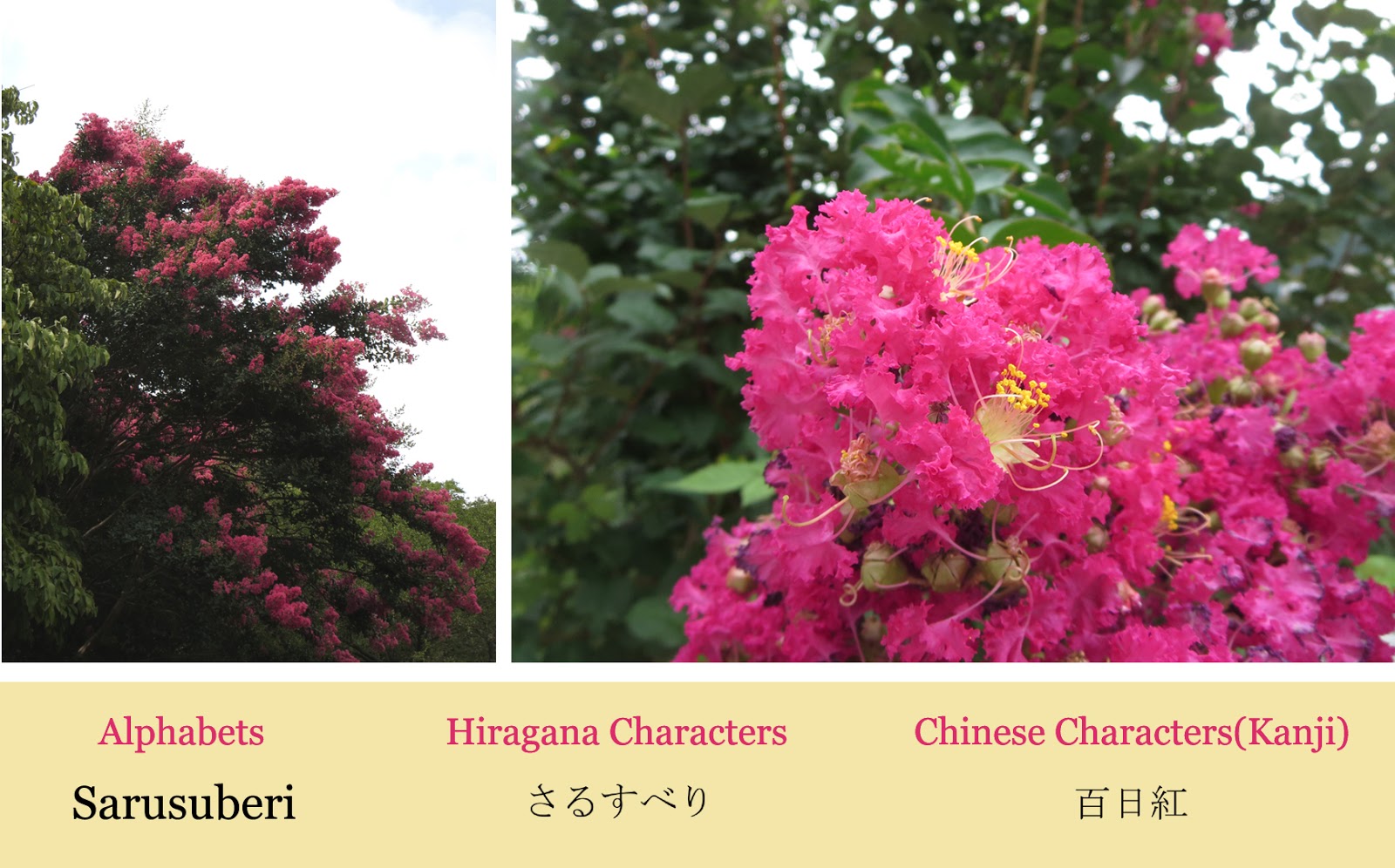
“Sarusuberi” is one of the typical mid-summer flowers in Japan and is blooming everywhere in Tokyo area as you can see in the photos above. This plant belongs to Indian Lilac, although the name may sound like some kind of berry to you. It is just a coincidence that the name sounds like berry but it has no connection to any berries because it’s a completely Japanese name. 

The name consists of two words “Saru" and "Suberi” and they means “Monkey would slip”. Because of its very smooth bark probably ancient people thought even monkey would have some difficulty climbing up the tree. Well, I don’t know if anybody had ever checked if it is true.

Anyway, it is a kind of funny name even though the flowers are beautiful, but the name is normally written in three Chinese characters (Kanji) that mean “Hundred Days Red” giving a completely different atmosphere. These characters do not have any logical connection to the pronunciation “Sarusuberi”. However, Sarusuberi flowers last a long time and therefore “Hyakujitukou(Hundred Days Red)” is actually another name of Sarusuberi flowers although it's not well known. 

Somehow people have been using “Sarusuberi” verbally but “Hundred Days Red” in a written form, and the two were combined to describe the same flower. Since Japanese use 3 different types of characters, two of which are phonetic and one of which is ideogram and non-phonetic, this type of mixing phonetic sounds to non-phonetic writing sometimes happen to Japanese words.

In addition, I'm showing Sarusuberi in one of Japanese phonetic characters called "Hiragana", and in non-phonetic Chinese characters called "Kanji" below the photos of the flower as a reference.

Monday, August 15, 2016

A Historical Beckoning Cat (Maneki-neko) Which Survived An Air Raid

August 15th is called "The Memorial Day For The End Of The War" in Japan. It is the day commemorating the end of the Second World War because Japan's surrender was announced to people on August 15th in 1945.

There are some survivals of the Second World War even today and actually you can see one of them in Hachioji City, Tokyo. It is a big beckoning cat 
(Maneki-neko) displayed in a local shop near Hachioji Station.

It is called “Beckoning Cat Having Great Luck”, although beckoning cat  is originally a traditional lucky charm to invite luck to people, because it survived the Hachioji Air Raid in 1945. Apparently about 80% of buildings in Hachioji were damaged by the air raid, but the cat figurine wasn’t destroyed though it got some burns. 


Since some time people started to put monetary offerings in front of it and now an offertory box is placed there. There is also a notice that tells the shop owner recently donated the money to the Medecins Sans Frontieres with his prayer for peace.