I introduced an international gods group called "Shichifukujin (Seven Good Luck Gods)" in my previous post on the October 2nd. The Shichifukujin gods are very popular and many Shinto shrines and Buddhism temples all over Japan worship them separately.
In the Shichifukujin Gods, only "Benzaiten" is a goddess. In Japanese language, there is an idiom to express this situation. When people see only woman in a group she is called "Kouitten (a red dot)" in the group. So we can say "Benzaiten" goddess is "Kouitten (a red dot)" in the gods group.
The origin of the idiom is an ancient Chinese poetry and it was telling about only red flower blooming in a green bush and it is standing out. Then the word turned to be used for the situation that there is only woman/girl in a group.
Unfortunately there is no antonym of the idiom for a man in a women's group. Perhaps we should create a new idiom like "only green dot for the opposite situation?
The shrine in the lower photos is a "Benzaiten Shrine" inside of Yakuo-in Temple on Mt. Takao in Tokyo. It is inconspicuous and located in backside of temple buildings, so it would be a kind of off-the-beaten-track place on the temple ground. When you have a chance to visit Mt. Takao Yakuo-in Temple, please check the hidden "A red dot of Shichifukujin" shrine!
Showing posts with label Japanese language. Show all posts
Thursday, October 13, 2016
Sunday, August 21, 2016
What Is The Difference Between These Two Twilight Time Photos?
These photos were taken from west side of Tokyo right before the sunrise and right after the sunset. In Japanese there are traditional words for these time periods as the word “twilight time” in English.
In both time-frames similar conditions will happen, such as everything are covered by the faint light and the view becomes unclear. However Japanese has different words for them although the word for "evening twilight time" is somehow used more frequently nowadays.
In evening it is called “Tasogare-doki”. The meaning of it is “The Time of Who-is-he” because it is the time with too dim light to tell who is the person over there. I know you may think the definition would fit the time-frame before daybreak, too. Then what is the word for morning twilight? Well, the time frame is called “Kawatare-Doki”. The meaning of it is actually “The Time of He-is-who”.
Yes, it is just same meaning as the former though the words order is switched. It is a funny word play created by ancient people but in fact efficient. People can tell which time frame it is by these playing words immediately!
Wednesday, August 17, 2016
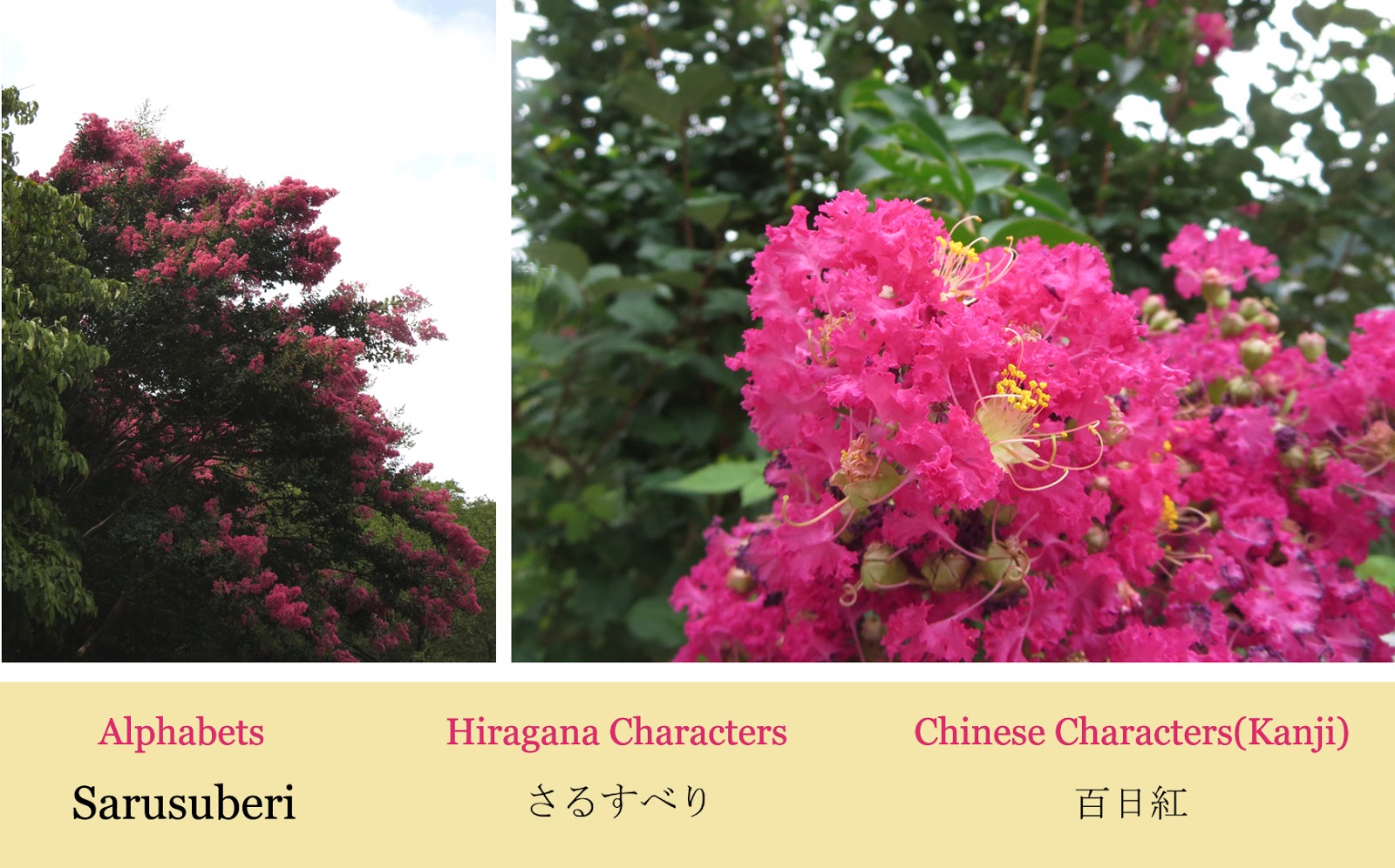
A Funny Name And A Beautiful Name Are Fused In A Summer Flower
“Sarusuberi” is one of the typical
mid-summer flowers in Japan and is blooming everywhere in Tokyo area as you can see in the photos above. This
plant belongs to Indian Lilac, although the name may sound like some kind of
berry to you. It is just a coincidence that the name sounds like berry but it has no connection to any
berries because it’s a completely Japanese name.
The name consists of two words “Saru" and "Suberi” and they means “Monkey would slip”. Because of its very smooth bark probably ancient people thought even monkey would have some difficulty climbing up the tree. Well, I don’t know if anybody had ever checked if it is true.
Anyway, it is a kind of funny name even though the flowers are beautiful, but the name is normally written in three Chinese characters (Kanji) that mean “Hundred Days Red” giving a completely different atmosphere. These characters do not have any logical connection to the pronunciation “Sarusuberi”. However, Sarusuberi flowers last a long time and therefore “Hyakujitukou(Hundred Days Red)” is actually another name of Sarusuberi flowers although it's not well known.
Somehow people have been using “Sarusuberi” verbally but
“Hundred Days Red” in a written form, and the two were combined to describe the same flower. Since
Japanese use 3 different types of characters, two of which are phonetic and one of which is ideogram and non-phonetic, this type of mixing phonetic sounds to non-phonetic writing sometimes
happen to Japanese words.
In addition, I'm showing Sarusuberi in one of Japanese phonetic characters called "Hiragana", and in non-phonetic Chinese characters called "Kanji" below the photos of the flower as a reference.
Labels:
Hiragana,
Japanese language,
Kanji,
Seasonal Flower,
Summer
Subscribe to:
Posts (Atom)